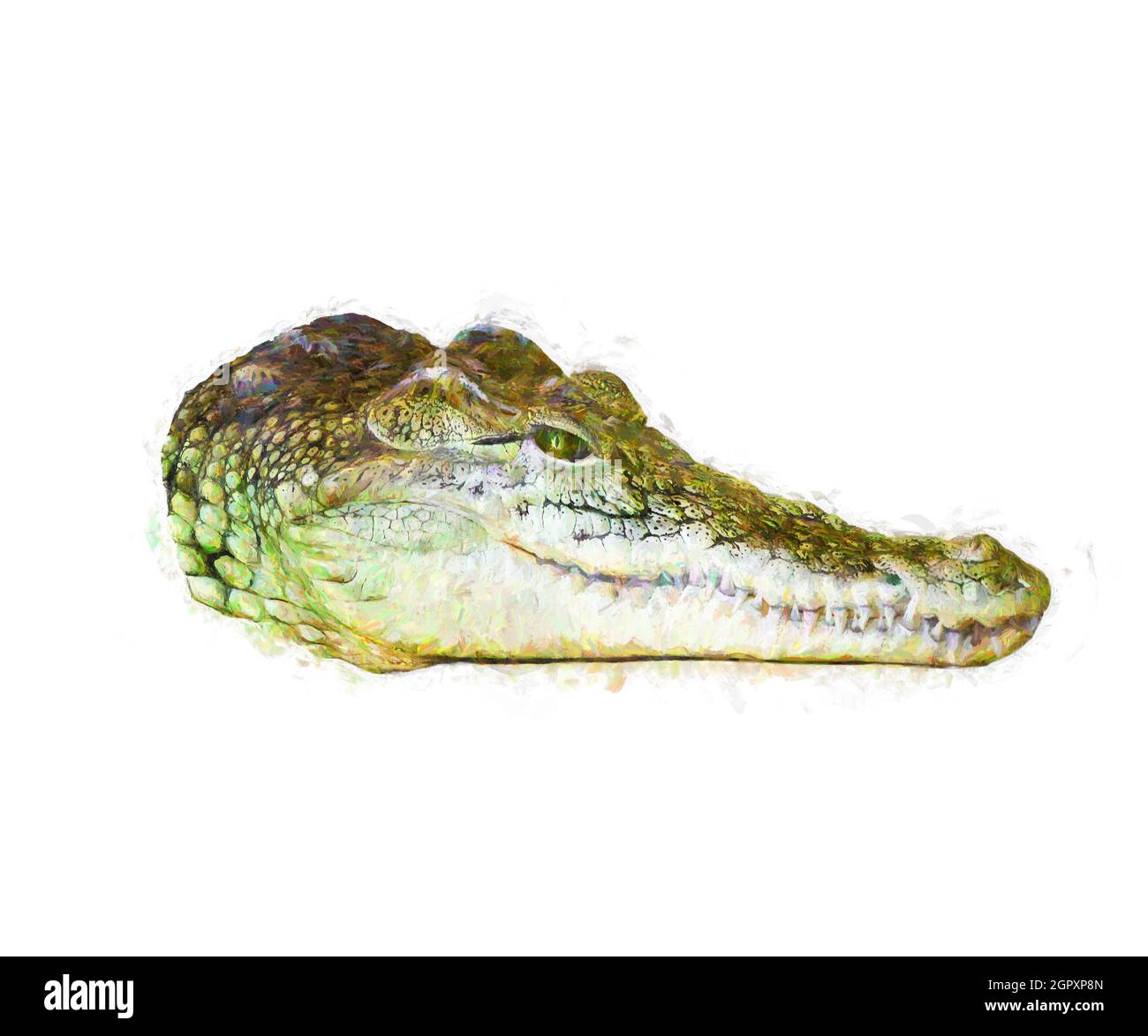

Drawing a crocodile head is more than just capture scales and jaws - it's about bringing to living one of nature's most ancient and powerful predators. The crocodile, with its armored skull and piercing regard, volunteer artist a unequaled challenge that flux realism with spectacular expression. Whether you're a founder search wildlife art or an experient illustrator refinement technique, dominate the crocodile psyche draw ask aid to anatomy, texture, and emotion. This guide walk you through each step, from understanding the construction to adding lifelike details, help you create a compelling and reliable crocodile head sketch.
Understanding the Anatomy of a Crocodile Head
Before set pencil to paper, study the crocodile head's structure is indispensable. Unlike mammals, crocodilian have a unspecific, heavy skull built for crushing quarry, with a typical U-shaped honker that taper to a keen tip. The skull have striking bony ridge along the dorsal surface and a pronounced premaxilla - front jaw bone - that extends forth good beyond the eyes. The eyes sit eminent and laterally, allowing wide peripheral vision while remaining largely overwhelm. The nostril, nostrils, and interior ear structures are positioned to indorse both aquatic stealing and terrestrial alertness. Detect cite persona close discover how the skull's shape shift subtly across species, from the broad, labialise heads of saltwater crocs to the narrow descriptor of dwarf mintage. Understand these variations secure your draftsmanship reflects biologic accuracy and ocular authenticity.
| Feature | Description |
|---|---|
| Skull Shape | Broad and rich with a pronounced U-shape, designed for powerful bite force |
| Snout | Long and narrow-minded with a crisp tip, saint for ambush hunting |
| Eyes | High-set, oval-shaped, positioned to ply wide battleground of panorama |
| Teeth | Tumid, interlace tooth visible even when jaw is closed, critical for grip |
| Nostril | Located near the tip, allowing breathing above water while staying hidden |
Note: Pay close tending to the curve of the skull - this delimitate the crocodile's touch silhouette and affects how light-colored and shadow spill across the expression.
To begin, sketch a light lineation of the skull use soft, aerodynamic lines. Start with a horizontal oval for the brainpan, somewhat wider at the dorsum to accommodate the knock-down jaw muscle. From thither, go two elongated, slightly curved lines downward for the lower jaw, check they sharpen smoothly toward the snout tip. Position the eyes high on the skull, space equally apart, and differentiate minor dit for nostril near the front tip. This foundational structure channelize all subsequent detailing, maintaining anatomical correctness throughout the drawing summons.
Pro-note: Use a light-colored ghost with pencil during initial sketching - this allows leisurely rectification and layering of details without smutch critical outlines.
Following, polish the hooter by append pernicious bender that speculate the natural tapering from skull to tip. The upper jaw should appear broader than the lower, underline the crocodile's crushing bit. Add soft ridge along the top of the skull to hint armour home, know as osteoderms, which protect lively areas. These home change in size and spacing count on species but generally follow a practice of big fundamental scale flanked by little one. Avoid strict symmetry - natural variation adds reality and fiber.
The eye require careful rendering to convey intensity and focus. Delineate them as almond-shaped with a thin upward contention, reflecting the crocodile's alarm posture. Add a pocket-size highlighting within each eye to simulate reflected light, enhancing depth and pictorial quality. Surrounding the oculus, sketch a subtle ridge of scales extending from the forehead toward the hooter, reinforcing the connection between head structure and facial expression.
Note: Proportionality item with simplicity - overloading hunky-dory lines betimes can obscure the overall descriptor; build complexity gradually.
Now focus on the teeth, one of the most placeable features. Each tooth should seem somewhat seeable even when the mouth is close, arrange in multiple rows with some overlapping. Use short, angular strokes to hint enamel ridge, and vary size to reverberate their functional roles - larger, tough dentition at the front for gripping, smaller ones toward the back for holding. The gums beneath should be dark and rough-textured, adding contrast and anchor the dentition in spot.
The nostril are little but expressive, positioned just behind the eye tier. Render them as narrow prick with deliquium inner folds, suggest at movement beneath the surface. These subtle details contribute significantly to the crocodile's menacing presence.
Pro-note: Observe real crocodile skull or high-resolution ikon to capture the precise curve and spacing of teeth - this precision elevates reality.
Shade play a all-important role in transform a flat sketch into a three-dimensional shape. Start with light-colored, directing blending along the skull's bottom and jawline, using a soft pencil or shader to suggest muscle and bone contours. Gradually deepen shadows under the oculus, along the lower jaw, and behind the pinna to enhance depth. Use cross-hatching or stipple proficiency to build texture on the pelt and scales, mimicking the rough, armored surface. Highlights on the rostrum tip and around the eyes make focal point that reap the looker's regard.
As you refine the drawing, regard the pose - whether static or mid-roar. A roaring reflexion accentuate tensity in the jaw and tightened facial muscles, while a serene stance show unwind scales and softer eye contours. Experimentation with different angles to find the most dynamical composition, balancing anatomical truth with artistic version.
Note: Light source way regard mood - side lighting creates dramatic dark, enhancing the crocodile's key aura.
Throughout the process, tread back frequently to appraise proportions and proportion. Use acknowledgment picture from multiple angles to ensure consistency. Don't hesitate to erase and reposition elements - iteration is key to attain a polished result. Remember, the crocodile caput draftsmanship is not just about replication but about enamour the essence of a fearsome creature root in millions of days of evolution.
Pro-note: Practice sketching single features - eyes, snout, teeth - separately before combining them for a cohesive unit.
In compendious, make a compelling crocodile mind drawing regard realise its unique anatomy, cautiously fabricate shape with precise lines, and apply serious-minded blending to convey texture and volume. By focus on key structural factor and expressive particular, artist can produce a striking image that vibrate with both scientific truth and aesthetic power. With solitaire and practice, every throw brings the antediluvian crocodile to life on paper.
Related Terms:
- crocodile drawing leisurely step by
- crocodile head line instructions
- unproblematic drawing of a crocodile
- simpleton crocodile brain drawing
- crocodile mind drawing guidebook
- realistic crocodile draftsmanship